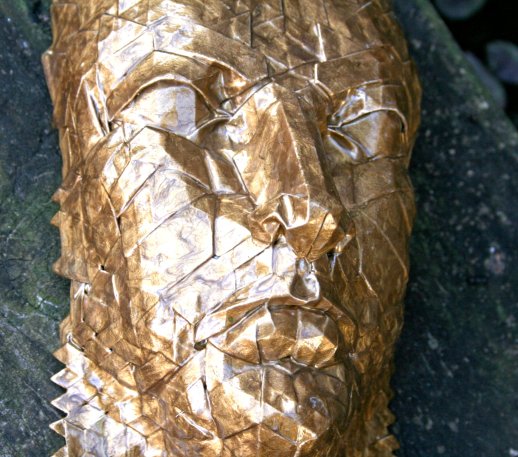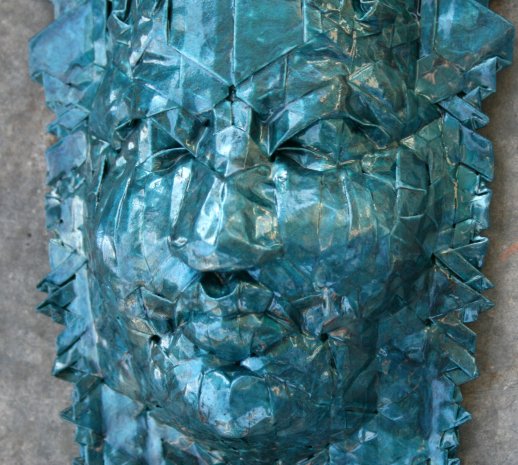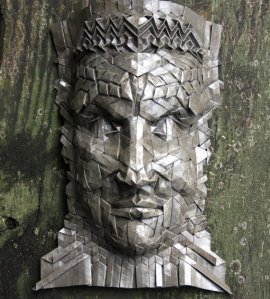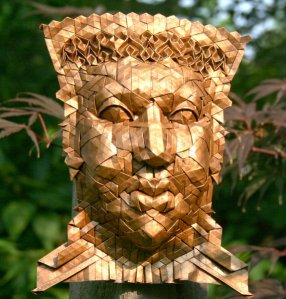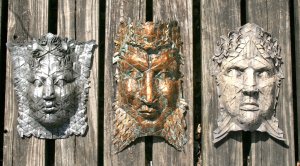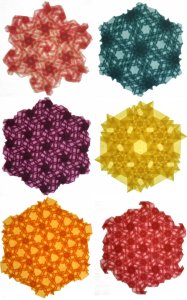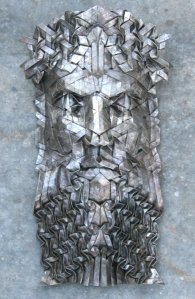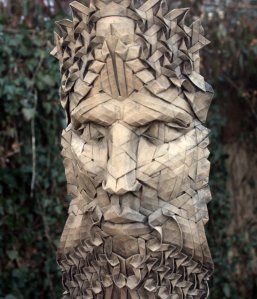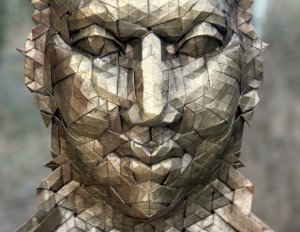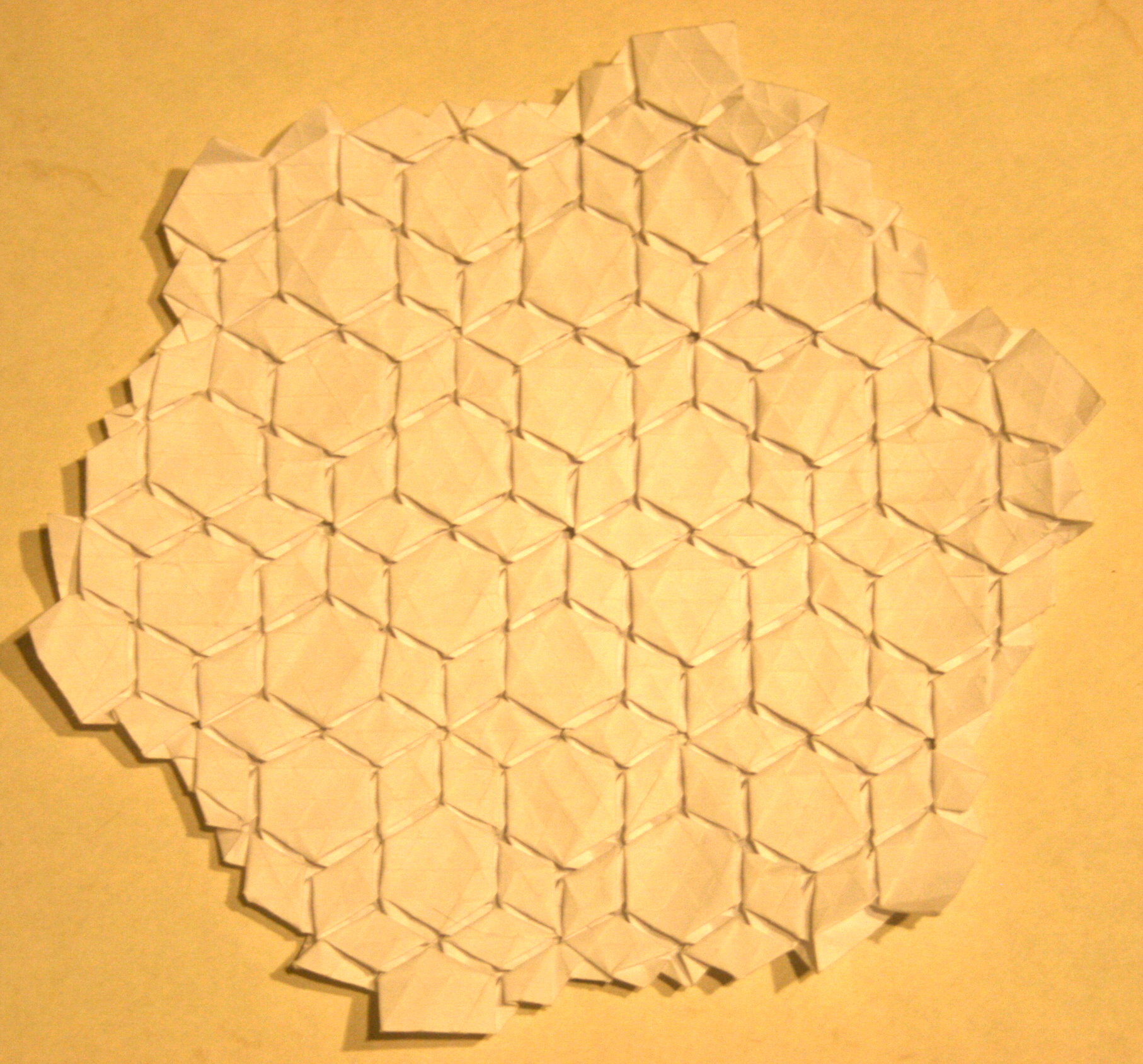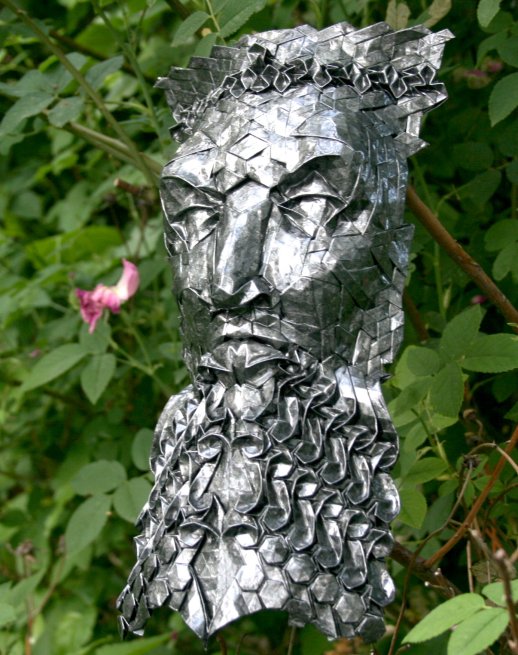
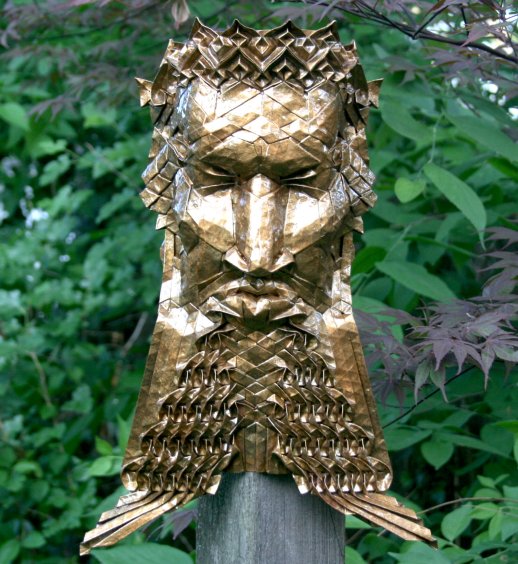
When I first came across origami tessellation online about twelve years ago it was not from a search for origami, it was from a website for geometry enthusiasts. It should be no surprise that this particular form of paperfolding seemed to spring up among mathematicians and scientists – those who find satisfaction in order and elegant solutions to complex problems. Nor should it be a surprise that the earliest practitioners of origami tessellation often had names adorned with letters fore and aft, such as “Dr.” and “PhD”. The name “tessellation” used to designate this kind of origami was borrowed from the field of mathematics, referring to the regular division of a plane by repeating geometric shapes. 
“Tessellation” from “tesserae”, the little squares of stone or glass used by the ancient Romans to create mosaics.
Now there are a couple of ways to go about designing a new tessellation. The technique I settled upon years ago was to pre-crease a grid in a piece of paper and then using the geometry of the grid alone, start folding in an improvisational way and see what works and what doesn’t. It can be hit and miss, but it suits my style. Another approach is to plan the design out first and create a crease pattern before you begin folding. Origami really is math incarnate, so if you know the math you can have a fairly good idea if a design will work before you make your first crease.
You could even create software to help realize your ideas.
Alex Bateman has a scientific approach to origami. He also divides his time folding with such things as classifying non-coding ribonucleic acids. I believe I first encountered his work (origami, not genetic) on his user page at the Sanger Institute website when I was just getting my feet wet in the whole origami tessellation thing, many years ago. That page is gone but he has a website of his own since around 2006. That’s absolutely ancient in internet time, but it is still a valuable resource, not just for images of his own work but for the Tess software and e-books that are available there.
And though he has been on a bit of an origami hiatus, happily he is still folding and creating new crease patterns to share.
As his nom de pliage “Paper Mosaics” implies, Alex is true to the literal meaning of Origami Tessellation: folded paper mosaics. He explores the great variety of geometric forms that can divide a plane, many that would be difficult if not impossible to replicate from a pre-creased grid.
If you are new to tessellation then you might not be aware of his work, but I highly recommend having a look. It will inspire you as it had inspired me. He can even show you how to fold your very own origami DNA double helix.
I can’t tell you how hard it was for me to write that post title; the grammar nerd in me cringes. But I am trying to reform and accept the natural evolution of a living language (I will not, however, give up my semicolons). After all, when you are too uptight about proper written language you expose your own writing skills to increased scrutiny. My writing is not perfect.
Language has always interested me because it does evolve and like a living species, its current form reflects the adaptations of environmental pressures upon the contingencies of previous forms. You can look at any animal and among all the adaptations that suit that creature to its natural ecological niche, you can see traces of previous adaptations that no longer serve any purpose. You needn’t look any further than your own body for examples. Take goose bumps.
Goose bumps, goose pimples or goose flesh, are caused by tiny muscles at the base of each hair contracting to make the hair stand up. It’s called the piloerection and most mammals have this reflex in response to fear or to cold. The hair standing on end makes the animal appear larger to intimidate whatever is frightening the poor beast. It also traps more air to insulate the animal from cold. Of course humans don’t have nearly enough hair for either result to be effective, but we still have the reflex. It is a vestige of our hirsute ancestry.
The English language has goose bumps. I thought of this when I heard someone on the radio say that something had “whet his appetite”. This is a fairly common expression, but the “whet” part isn’t all that common in spoken English. There are many expressions in English that use the sharpness or the act of sharpening as a metaphor, when you think about it. The word “sharp” itself can mean someone who is clever or fashionable (on the “cutting edge”). Your interest or attention may be “keen” and you “hone” your skills. But honing, whetting and keen are these days perhaps less recognized as referring to blades as they are for their metaphorical meanings. I suppose it could be that people just don’t sharpen their tools much anymore. The word “whet” has the added disadvantage of being a homophone for the much more common “wet”. One usually uses a whet-stone to whet their blade. A whet-stone is generally moistened with oil or water for the purpose, making it a wet-stone as well as a whet-stone, and a blade is wet when it’s whet. So I can see how people get confused about the whole thing. Although “wet his appetite” doesn’t make a lot of sense as an expression, how else would people hear it if they aren’t familiar with the word “whet”? Besides, people often use expressions without knowing what the words really mean. And such idioms are often the only time you will hear certain words that are no longer in common currency. Idioms trap words in the language like insects trapped in amber. Occasionally something will pique your curiosity or your interest, but how often have you piqued yourself when you felt pride, or been piqued when your pride was deflated, or piqued your friends by using obscure words in conversation. “Pique your curiosity” is still a common expression, but people could be forgiven for thinking “peak your curiosity” when they hear the phrase if the word “pique” is otherwise alien. And it’s another darned homophone. The English language is full of them and that’s part of the problem right there. The English language is a hodge-podge of languages all cobbled together around a loosely Latin syntax. Pique comes from the Old French “piquer”, to prick, which in turn is derived from the Vulgar Latin “piccare”. Peak possibly comes from the Old English “pic” for a sharp pointy thing (like a pike) which is ultimately derived from the same root as pique but through a different etymological path. There’s really no good reason for us to have two words that came from basically the same root be spelled so differently yet be pronounced exactly the same. Similarities in spelling should indicate a common root and divergences in pronunciation should indicate changes in meaning. But the English language seems to have infinite ways to spell things but not many ways to pronounce them. At least the spellings bear evidence of the words’ peregrinations, even if the lazy English tongue (or even lazier American tongue) makes them all sound the same. These are the goose bumps that arise from time to time to puzzle, amuse, perplex or pique us with evidence of the language’s convoluted past.
So I can be a stickler for spelling – not because of some arbitrary adherence to rules, but because the way words are written gives clues to the word’s history. To misspell a word is to obliterate it’s history.
Consider our strange relationship with the letter H. The English language sticks H’s everywhere and seemingly for no reason since many of them are silent: the H in what, where and why. H is used to change the sound of hard consonants to soft in combination – like C to CH or S to SH but it also changes some letters in arbitrary ways. Why is the GH in “enough” pronounced like an F, but in “bough” the GH is silent and “ghost” the H does nothing at all? These are all presumably vestiges of our language’s tortuous history and it may be at different times and under different conditions the H was doing exactly what people expected it to do. But the H lingers long after its reason has gone.
Until just a few years ago I thought whoa was spelled “whoa”. That’s how I had always seen it written. Granted, as a verbal interjection, you were more likely to hear it spoken than to see it written. But one phenomenon of the ubiquity of the internet and electronic media is the return of the written word. After a long hiatus when people communicated only by phone (that’s telephone, not iPhone) and folks lamented the demise of written communication and predicted that illiteracy would return, people are writing again. Well, sort of. E-mail, blogging and texting – it tends to be informal almost to the point of practical illiteracy. For many there is no distinction in style between written and oral speech; they simply write exactly the way they talk. So if you say “whoa” in oral conversation, you write “whoa” in written conversation. Problem is, there are words you hear spoken all the time but you seldom see them written. English being the way it is, you learn how to write by reading. There are rules, but there are so many exceptions to those rules that it’s best to simply expose yourself to proper writing by reading as much as you can until you just get a sense for what is correct.
But you can read half a library’s worth of books before you see “whoa” in print. Before Keanu Reeves, it wasn’t even in common parlance outside of horse ranches. Now it’s everywhere and if people are inclined to say it, they are compelled to write it. But how is it spelled? When I first saw “woah”, I assumed that the writer had a just vague notion that it started with a W, it had an OA and there’s an H in there somewhere; tossed the letters together and hoped for the best. They couldn’t be bothered to check the spelling on such an inconsequential word. Or maybe they weren’t speculating on the spelling but actually thought that this was correct. But had they seen it written that way before? That is the only way they would think the spelling is correct, since the spelling of “whoa” is arbitrary. The word existed a long time before anyone bothered to write it down and as a simple mono-syllabic interjection, more of a yelp than an actual word, you could spell it any way you pleased. Yet the spelling was formalized, since some people really like rules, and consensus spelled it “whoa”. Didn’t they? The problem is, people are more likely to read the word “whoa” (or “woah”) on the internet than in any book. So is that where consensus should lie? When people type the word “whoa” or “woah”, they are likely to judge its correctness by what they have seen before. And what they have seen before was on the internet, not in a book, and there’s about a 50/50 chance which way it might have been spelled.
Then there’s grammar, and a problem: when do the rules help communication, and when do they hinder?
Where you at?
At first blush this would seem to be no more than an example of atrocious grammar. At least that’s how I reacted when I first heard these words spoken. But now I’m inclined to defend to defend this construction. Grammar is, after all, a way to make oneself understood, and the above question is not only understandable but its form clarifies the kind of response the interlocutor desires. The proper phrase should be “Where are you?”, but this could be interpreted in several ways. Think of context: When would somebody ask this question? If you are talking to someone face to face, you know where they are – they’re right in front of you. If you are speaking to someone on their home phone, you know where they are – they’re at home, on the phone. If you write someone a letter, you know where they are (you addressed the envelope). Maybe you are in the dark and you can hear someone but not see them. You might ask “Where are you?” and they might respond “Over here.”
But more likely you would ask this question when talking to someone on a cell phone. This is the most common situation in which you would know someone can hear you but you don’t know where they are. In fact, I would go as far as to say that the cell phone is the single reason that the phrase “Where you at?” became not only common, but in a sense necessary. Before the cell phone, the very fact that you could communicate with someone at all meant you usually had a fairly good idea where they were. They were either right in front of you or they were on the other end of a telephone line. If you asked someone where they were, it was likely you were asking them to clarify their location in some relative way; you are asking because they are not where you expect them to be. They are calling from a phone booth (“Where are you?”) or they are at home instead of picking you up at the airport (“Where are you?”). The simple question can be interpreted in different ways and may be an invitation to an explanation.
But after the cell phone, talking to someone no longer meant you had a clue where they are. You might even call someone just to ask them where they are, something which had previously been impossible (and redundant). You had to know where someone was if you wanted to contact them. Well, unless you had a walky-talky. Then you might ask for someone’s co-ordinates. “Where you at?” is just an informal way to say “Give me your co-ordinates”. That’s the purpose of the “at” at the end of that question. It is contrary to the well-known proscription against ending a sentence with a preposition and it should be redundant besides, but it actually serves a purpose. The “at” frames the desired response – an object of the preposition, e.g. at home, at the store, at the laundromat, at such-and-such address. The ungrammatical “at” clarifies the kind of answer the question demands: a clear, physical location. Whereas “Where are you?” can be inflected to require a relative answer (“Why are you there and not here?”), “Where you at?” is unambiguous. And forget about that never-end-a-sentence-with-a-preposition business. A preposition needn’t always be followed by an object and English syntax allows the preposition at the end of a sentence if the object of the preposition is implied or unnecessary. The “at” in the question “Where you at?” is implying the substantive which is the answer to the question. Of course the most heinous error would be the absence of a verb in the phrase “Where you at?”. Well that is a problem , but I say it’s really a matter of esthetics. “Where are you at?” sounds awkward. “Where’re you at?” isn’t much better. The “are” is really unnecessary when the “at” already implies a state of being “at” some location.
To make another strained analogy to biological evolution: consider the panda’s thumb. Pandas eat bamboo. To get at the good parts of the bamboo they need to grab and hold the stalks with their paws and peel the outer layers with their teeth. Thumbs are really good for grabbing and holding things but pandas evolved from carnivores that had already adapted their digits for claws. In fact, the ancestor bear’s claws were just too claw-like to reconfigure into an opposable digit, but other parts of the paw could serve the purpose. Over time, a bone from the wrist shifted in place and enlarged to form a rudimentary thumb.![]()
This is an over-simplification, and I invite you to read the late, great Stephen Jay Gould’s essay on the subject for details.
The panda is an odd beast, and one would not expect that a bear adapted for carnivory would become a giant bamboo eating machine, but it happened. And like a bear may have to find a thumb where none existed to become a new kind of animal, language finds a way to put itself together from its divers parts to communicate in a new way. After all, twenty or thirty years ago there were few occasions when the average person would find it necessary to ask someone “where you at?”. But this is the world we live in now.
And that’s where it’s at.
I mentioned previously the “bubble method” used to paint some of the papers I’ve used for folding. Here’s a little more about the technique and a little insight into folding a mask as well.
This will be black elephant hide painted with three different water-soluble paints: basic white acrylic, blue/gold metallic and gold/green interference paint. The combination of a basic contrasting color – in this case white to contrast the black paper – and a metallic color, seems to give good results and the interference paint has a subtle effect; it doesn’t have much color of it’s own, but creates a bit of a sheen on a dark background that shifts from one color to another in different light. My wife has collected many different kinds of paints, dyes and inks over the years and she likes to experiment with them in different combinations to see what they can do. This painting is such an experiment.
Three containers are prepared with a little bit of water, a glob of dish detergent and an equal blob of paint (proportions are approximate). The paints, soap and water are mixed thoroughly and brought out to the paper which has been laid out on a bunch of newspaper (the following process can get messy).
And the bubbling begins!
Just stick a straw in the paint mixture and blow. You probably used to do this in your milkshake as a child, to your parents’ consternation. Maybe you still do. The technique is pretty much the same, except the soap will make the mix foam up rapidly.
Now my wife found this technique online and in that tutorial it was recommended to foam up a large bowl of paint and holding the paper over the bowl, lower it into the bubbles. The paper we have here is too large to do this and the bubbles don’t really want to stick to the elephant-hide paper (one of the qualities of elephant-hide is that it is relatively stain resistant). So we lay the paper out and spoon the foam onto the paper.
Just pile it on.
Now you have to wait a while for the bubbles to dry and break down and on elephant hide the effect is fairly subtle. Once the above mess had dried, my wife did it all over again for another layer and it was still fairly subtle, but the over-all effect is a kind of cloudy, cobwebby distribution of color. Very nice.
Paper successfully painted and looking much better than it did before, I have to figure out what to do with it. I had been doing some modifications on the recent “Oread” design that I was eager to try out, and I thought it would be worthy of some really nice paper. Only one potential problem: the mask is 96 creases across at a minimum and the paper is 35cm wide.
Let me explain. Each model has a minimum number of folds necessary to fully realize the form. Whatever grid I use must have at least that minimum number of creases to accommodate them. More complex pieces have more folds. Most of my earlier masks are on grids 64 pleats across. The more recent designs have more complex folds and require grids 96 pleats across. The numbers aren’t arbitrary – the grids are folded by either dividing the paper in half or in thirds and then dividing each of those sections in half, and each of those halves in half, and so on until the proper number is achieved (this is an “accordion” or “fan” fold). Ultimately, the number of divisions will equal x times 2 to the nth power, where x is the starting number of divisions and n is the number of times the divisions are halved. So if you start with a paper divided in two and then divide each section in half 5 times, you get 2 times 2 to the fifth power = 64 divisions. If you start with paper divided into thirds, you get 3 times 2 to the fifth power = 96. Trying to get a grid with a number of divisions that doesn’t follow this formula gets messy, so I try to stick with grids that are 32, 48, 64 or 96 divisions across.
Usually this works out fine, because the paper I use comes in sheets 100 x 70 cm. I can cut it in half and get a piece of paper 50 cm. wide for a grid 96 pleats across and each pleat will be a little more than 5 mm. wide – a good size to work with. I can cut the paper into quarters and have sheets that are 35cm. wide that will take a grid 64 pleats across and the pleats will still be a little over 5 mm. wide.
But what I have here is a piece of paper 35 cm. wide and I need a 96 pleat grid for the mask I wish to fold. The pleats will end up being almost 3.5 mm. wide. That’s a little smaller than I would like. But not impossible.
The paper is actually about 34 cm. across; I had to trim the edges a bit. You can see in the back view below that the pleats are about a third of a cm. wide. The paint doesn’t effect folding much. I didn’t crack or flake off. The paint or the soap or the combination of both gives the paper a slightly waxy feel, but the paper still folds cleanly.
The design I’m going to fold is recorded in this rather sad looking piece of paper.
You can see the remnants of a face in the front view. Below that is the back view, which actually has the most useful information – all the nuts and bolts that hold the design together. It looks a mess because it has been folded, unfolded and folded again over and over as I worked out the right combination of creases to get what I wanted. It will serve as a sort of road map when I start folding the new mask. I don’t write down or diagram anything – I just have a bunch of these partially folded pieces that I use for reference.
I started folding at the top and worked down the center line and on the left side of the face, consulting the “road map” with each fold.
At this point. more than half of the mask has been folded, and I don’t need the road map anymore. The mask is symmetrical so I can use the information on the completed side to fold the rest of the mask.
Finished!
My favorite paper has excellent properties for folding but it only comes in a few colors: black, white, and few shades of gray and brown. Fortunately, some of the characteristics that make it great for the my style of folding – its strength, its surface, consistent texture and its ability to accept moisture without much distortion, make it great for painting and dyeing as well. Now I’m pretty good at folding paper, but my wife is a genius at color.
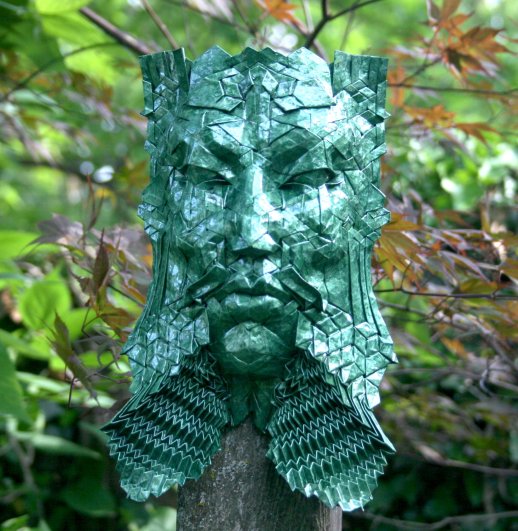
She has tried some new techniques for enlivening the rather blah papers that I like to fold. You can see some of the results in my latest mask, Alberich.
The technique is very interesting: she mixed water-based paints with dish detergent and water and used a drinking straw to blow bubbles into the mix to get a nice bubbly foam. She then scooped of some of the foam and plopped it onto paper (I got to help. It was fun!). When it dries, the paint is deposited in a fine tracery that looks kind of like the veins in stone.
The effect can be as subtle or as dramatic as you want.
This is off-white paper with black and green paint.
This is black paper with metallic paints. The precreasing is done and it’s ready to be folded into…something.
In person, the colors are more subdued than they appear in the photograph. The paints are rather irridescent, so they flash at certain angles. I think it will look wonderful as a mask.
You can see a brief overview of origami tessellation by the origami historian David Lister for the British Origami Society here. This article, it should be noted, is probably about a decade old. A lot has happened with origami tessellation in the last ten years. You can find more recent information at the Origami Resource Center here.
Lister’s article mentions two pioneers who would be very influential in the later development of tessellation: Resch and Fujimoto.
Resch was more interested in architectural applications. In origami, his work would be more influential in what is usually referred to as “origami corrugation”
Fujimoto designed more traditional origami, but origami that was unusually geometric and abstract. Many involved pleats that collapse at their intersections to form petals or scales:
In some cases the pleats collapse in the same direction around their intersection , i.e., all clockwise or all counterclockwise, to form a new structure – a twist fold.
The above images and more useful information on tessellation can be found at Origami USA’s online publication The Fold.
This is from Andy Wilson’s old site SpunDreams, which was a huge influence on me when I began folding tessellations.
This is the stuff that got me started with Origami tessellation around the year 2000. Andy’s work was influenced by Chris Palmer’s Shadowfolds, which in turn were influenced by Fujimoto’s twist folds. I spent countless hours reverse engineering these designs. This is how I learned tessellation, and it’s not a bad way to do it, for while there are a lot more styles of folding that are called “tessellations” these days, just about everything you need to know about how to fold them can be learned from these earlier, Fujimoto inspired designs. And the patterns are often clearer and easier to understand.
All of which leads me ultimately to the real reason for this post…
I had been meaning for quite some time to create a sort of catalog of twist folds. With each new mask and tessellation, I try to do something I’ve never done before, and I’ve often created new twists to attack increasingly complex challenges. Now, you would think that since all of my pieces are folded on 60 degree triangle grids and there are only so many ways pleats could intersect on such a matrix, there should be a limited number of twists necessary to accommodate them. You’d be surprised.
I want to document the twists I’ve used, their characteristics and how I’ve used them. I’ve decided to break up this catalog into smaller easy to digest installments, maybe two or three twists in each post, or even just one if it is a particularly interesting twist. Whether it’s one twist or more, the posts will be called “Twist of the Day”, and this is the first.
The first TOD must be the most essential twists for a tessellator – the triangle twist and the hexagon, or hex twist (I’m only going to be dealing with triangular grids, since that’s what I work with). There’s a video tutorial for folding a hex twist here, which also has a link to a video tutorial for folding a triangle grid. Here’s a pdf from Eric Gjerde with instructions for folding triangle, hexagonal and square twists. I should provide a tutorial of my own, but for this post I’m just going to let others do the work for me.
These two twists are fundamental to any beginner in origami tessellation. They are the nuts and bolts of all my work, and if you’re starting out, you would do well to practice them until you can fold them in your sleep.
I’ll leave you with some images of my earlier work, from around 2005-2006, that feature these two twists. 


I’ve done tiny tessellations before. They’re fun and challenging in a different way than ordinary tesses.
They also have the advantage of taking much less time to complete. They may take two or three hours to fold, but that is a far cry from some of the very large, involved models that I’ve done which may take two or three weeks, or in some cases several months.
As an antidote to some of the larger projects I’ve been preparing for the past few months, I’ve done several tiny tessellations to break up the drudgery of precreasing very, very big grids. I’ve created a new set on my Etsy shop to sell these cute little tessellations and you can check them out here. 

Blog at WordPress.com. Theme: Nishita by Brajeshwar.